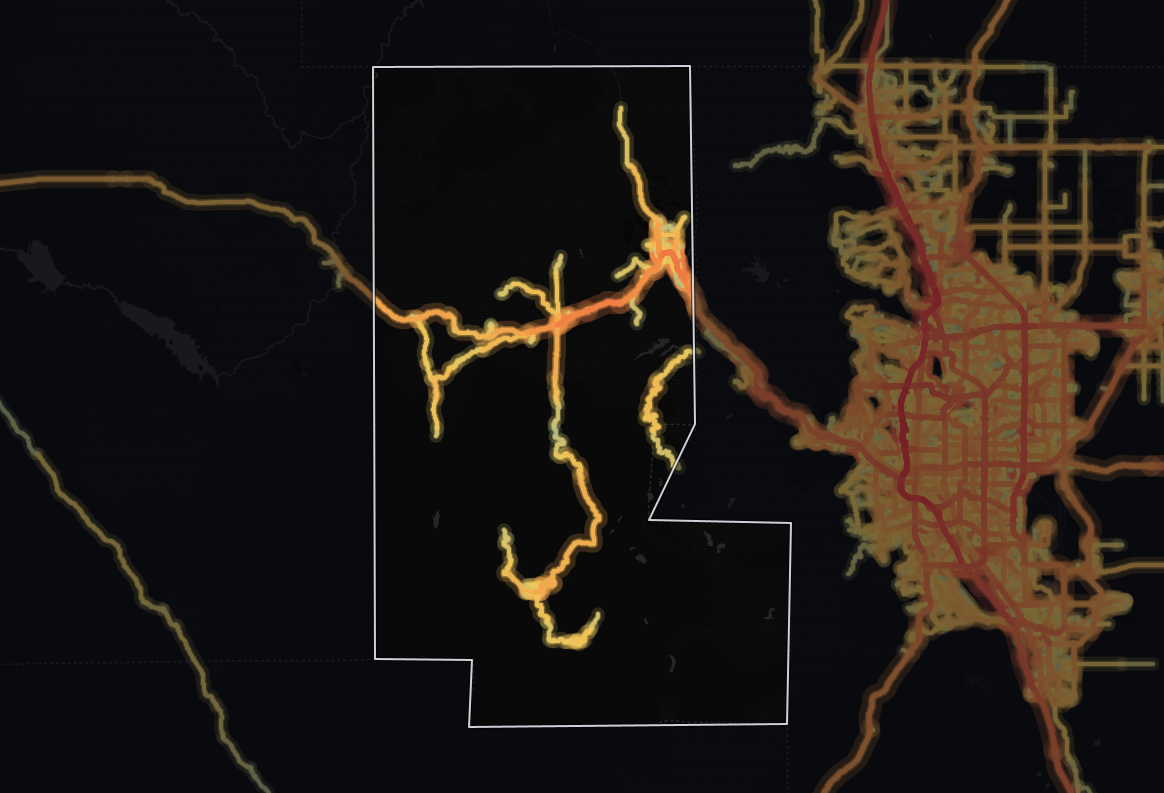
This page delivers traffic analytics for Teller County, Colorado. Our metrics are calculated with multi-sourced, cross-verified data from real-world mobile and sensor networks, and averaged for Teller County, Colorado among 125 road miles divided in 1,240 segments. Our metrics go beyond simple volume counts to provide actionable insights on traffic intensity, congestion, commercial vehicle flow, and network performance with highest possible granularity (average segment length is 534 ft). Whether you are evaluating a new retail location, planning logistics routes, or assessing infrastructure needs, this data helps you move from assumptions to certainty.
Data sourced from TrafficZoom's proprietary analytics platform.
The average number of vehicles that travel each day over any road in the road network.
3,429
Trucks
Trucks
The percentage of the total traffic volume composed of heavy vehicles.
7.7%
Average travel time
Average travel time
The average time of travel averaged among all vehicles traveling on the road network.
31.1 min
Congestion ratio
Congestion ratio
The rate at which the actual travel time exceeds free-flow travel time, averaged among all roads in the network.
11.6%
Drivers’ average age
Average age of residents in the geographic areas where the vehicle trips originated.
50.2 yrs
Drivers’ average income
Average income of residents in the geographic areas where the vehicle trips originated.
$87,634
Our data indicates an estimated average traffic volume of 3,429 vehicles per day in Teller County, Colorado that results in 385,140 vehicle-miles traveled per day (≈141 million per year). The traffic stream is comprised of an average of 1 truck for every 13 vehicles. Typical time spent behind the wheel per trip is 31.1 minutes, which already accounts for delays at signals, intersections, and congestion.
Analytical insight
When compared to the Colorado state averages: Teller sees 49% lower average daily traffic volume than the state average (3,429 vehicles per day against 6,752), suggesting less demand on each road - a critical factor for logistics and site planning. Across the whole network that adds up to 385,140 vehicle-miles traveled per day (≈141 million per year), roughly 0.3% of Colorado's statewide total. The average trip takes 31.1 minutes, 6% lower than the state level. Congestion runs 26% lower than the state level, at a ratio of 11.6% - smoother traffic flow - crucial for traffic control improvement and logistics planning. By volume, Teller's 3,429 vehicles per day outpaces 56% of counties in Colorado. 32% of counties in Colorado have a shorter average travel time than Teller's 31.1 minutes.
Highway vs. Non-Highway Traffic Analysis
Highway Traffic
Traffic
Traffic
The average number of vehicles that travel each day over any road in the road network.
10,263
Trucks
Trucks
The percentage of the total traffic volume composed of heavy vehicles.
6.9%
Average travel time
Average travel time
The average time of travel averaged among all vehicles traveling on the road network.
37.5 min
Congestion ratio
Congestion ratio
The rate at which the actual travel time exceeds free-flow travel time, averaged among all roads in the network.
26.7%
Drivers’ average age
Average age of residents in the geographic areas where the vehicle trips originated.
49.8 yrs
Drivers’ average income
Average income of residents in the geographic areas where the vehicle trips originated.
$88,728
A significant volume of traffic in Teller County, Colorado utilizes the highway network. The average highway carries 10,263 vehicles per day, 471% more than the average non-highway road in the same area, which carries 1,797 vehicles per day. That average covers 25 highway road miles divided in 239 segments (average segment length 553 ft), together carrying 245,686 vehicle-miles traveled per day (≈89.7 million per year). Trucks constitute 6.9% of highway traffic.
Analytical insight
At 6.9%, highway truck share is 39% lower than the state average, marking Teller as a primarily local traffic hub - underscoring the importance of local access for logistics operators. Teller's highway truck share (6.9%) is higher than 2% of counties in Colorado. By raw truck volume, Teller carries more highway trucks than 43% of counties in Colorado.
Non-highway traffic
Traffic
Traffic
The average number of vehicles that travel each day over any road in the road network.
1,797
Trucks
Trucks
The percentage of the total traffic volume composed of heavy vehicles.
9.2%
Average travel time
Average travel time
The average time of travel averaged among all vehicles traveling on the road network.
29.6 min
Congestion ratio
Congestion ratio
The rate at which the actual travel time exceeds free-flow travel time, averaged among all roads in the network.
8.0%
Drivers’ average age
Average age of residents in the geographic areas where the vehicle trips originated.
53.4 yrs
Drivers’ average income
Average income of residents in the geographic areas where the vehicle trips originated.
$85,022
The non-highway road network in Teller County, Colorado supports a substantial volume of traffic. The average non-highway road carries 1,797 vehicles per day, 82% less than the average highway in the same area, which carries 10,263 vehicles per day. That average covers 100 non-highway road miles divided in 1,001 segments (average segment length 530 ft), together carrying 139,454 vehicle-miles traveled per day (≈50.9 million per year). Trucks constitute 9.2% of non-highway traffic.
Analytical insight
Compared to highways, non-highway routes see 34% more trucks by share. Non-highway congestion (8.0%) runs 47% lower than the state average, pointing to smoother local traffic flow. Teller's overall average travel time exceeds 32% of counties in Colorado. 67% of counties in Colorado see lower average driver income among trip origins than Teller. The driver population here skews older than 70% of counties in Colorado.
Time-of-Day & Seasonal Patterns
Peak Traffic Windows
Weekday peaks:
AM peak 9:00 AM–12:00 PM and PM peak 2:00 PM–6:00 PM, with volumes reaching approximately 83% higher than the daily average.
Weekend traffic:
Weekend volumes run about 12% above weekday levels.
Seasonal Fluctuation
Busy season:
July–September is the high season, with volumes +21% versus the annual average.
Lowest month:
January is the quietest month, with volumes -22% versus the annual average.
Analytical insight
In Teller County, Colorado, the peak hour concentrates about 8% of the day's traffic, and seasonal swing is pronounced at +21% in high season.
Traffic Flow Profile Comparison
Metric
Teller
Colorado
Average
Difference
Traffic
3,429
6,752
-49.2%
Truck % (Total Traffic)
7.7%
8.4%
-8.5%
Truck % (Highway)
6.9%
11.2%
-39.0%
Avg. Travel Time
31.1 min
33.2 min
-6.2%
Frequently Asked Questions
The average daily traffic volume is calculated at 3,429 vehicles per day, providing a baseline for daily operations and site assessment.
Teller's highway truck share of 6.9% is higher than 2% of counties in Colorado.
Trucks account for approximately 7.7% of the total traffic mix across all road types, with a significantly higher concentration of 6.9% on highways.
Weekday peaks occur between 9:00 AM and 12:00 PM in the morning and between 2:00 PM and 6:00 PM in the evening - about 83% above the daily average.
The average travel time for drivers is 31.1 minutes, offering a standard metric for commute and delivery route planning.
Drivers on Teller roads have a median age of 50 years, and the median household income of the neighborhoods trips originate from averages $87,634 - useful context for retail siting and customer profiling.
Traffic volumes are typically 21% higher during July–September. Volumes drop to their lowest levels in January, averaging 2,675 vehicles per day - a 22% decrease from the annual average.
Approximately 18% of highway traffic and 4% of non-highway traffic consists of vehicles whose trip originates outside Teller County, Colorado. This indicates that a portion of highway traffic is regional pass-through, while local roads are more representative of resident and commuter activity.
Data Sources & Methodology
The data presented on this page is derived from TrafficZoom's proprietary analytics platform, which aggregates and normalizes information from multiple sources, including:
Mobile device location data (anonymized and aggregated)